

Five Star ANCAP Driving School for Safer Lessons
Uncategorized | 7 August, 2026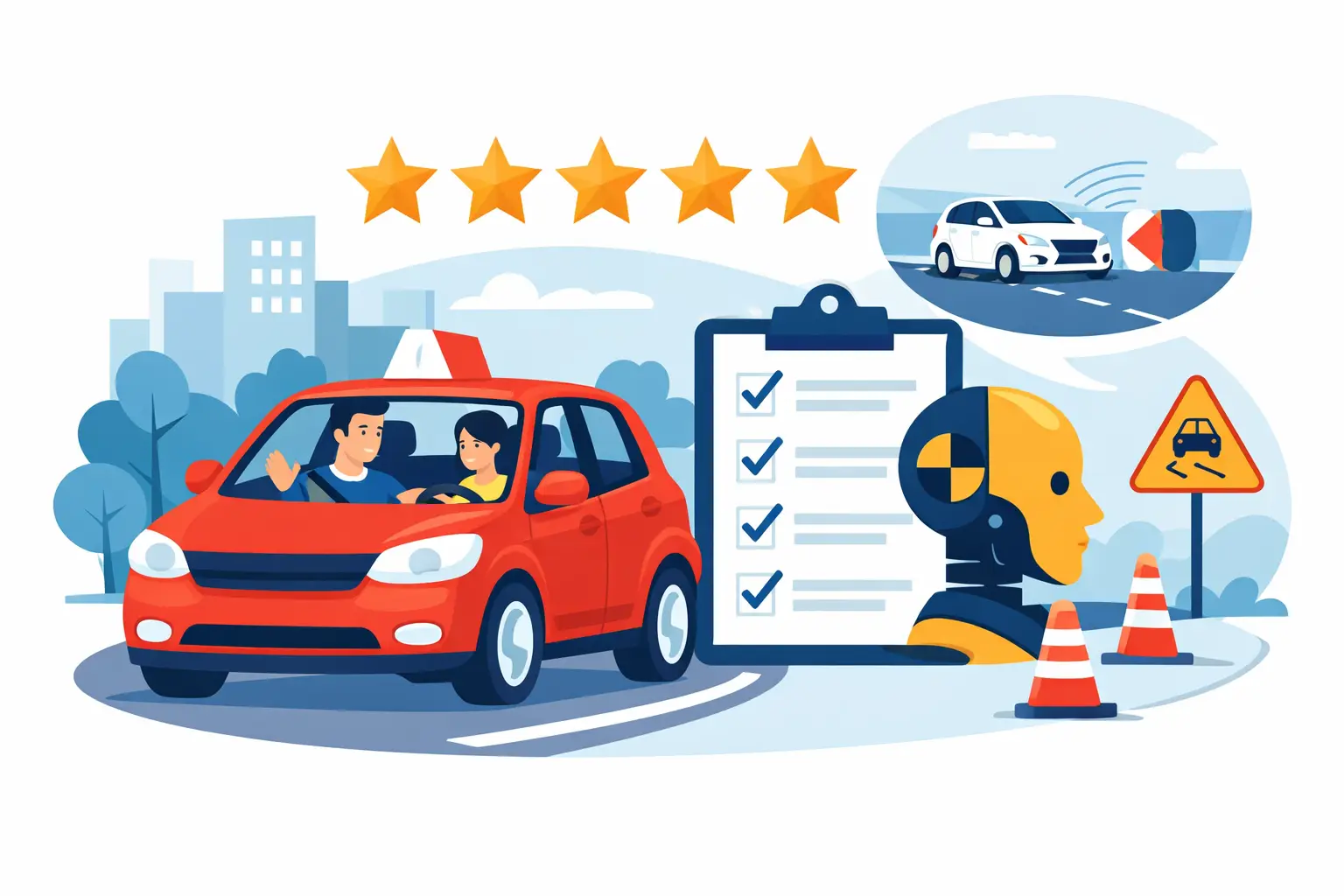
A learner’s first few hours behind the wheel can feel intense: traffic building behind you, mirrors to check, signs to read, and an instructor giving directions. Choosing a five star ANCAP driving school means the car supporting that learning is designed with safety as a priority, while the instruction helps you make calm, confident decisions on Melbourne roads.
For learners in Ringwood, Blackburn, Nunawading, Vermont, Glen Waverley, Box Hill, Mitcham, and nearby eastern suburbs, a driving lesson is not only about getting through the VicRoads test. It is time to build habits that protect you, your passengers, cyclists, and other road users long after the test is over.
What five-star ANCAP means for driving lessons
ANCAP assesses the safety performance of new vehicles sold in Australia and New Zealand. A five-star ANCAP rating is the highest rating available under the testing standards applied when a vehicle is assessed. It considers how well a vehicle protects occupants and vulnerable road users, as well as the safety technology fitted to the car.
For a learner driver, that rating does not replace careful driving or good instruction. It does, however, provide another layer of protection while you are developing skills. Lessons naturally include moments when you are still judging braking distance, lane position, gap selection, and steering control. A well-equipped, highly rated vehicle helps create a more reassuring place to learn.
At Green Signals Driving School, lessons take place in modern automatic dual-control cars selected for both comfort and safety. Features can include seven airbags, electronic stability control, anti-lock brakes, traction control, emergency brake assist, lane support, and instructor-operated dual pedals. The vehicle is also insured for driving instruction, giving learners and families added peace of mind.
Why the training car matters as much as the instructor
A patient instructor can explain a difficult maneuver clearly. A safe training car gives that instruction a practical safety net. Both matter, especially for a first-time learner or an overseas license holder adjusting to unfamiliar road rules.
Dual controls give learners room to learn
Dual pedals allow the instructor to intervene if a situation becomes unsafe. This is especially helpful at busy intersections, roundabouts, school zones, and during early parking practice. Knowing that an experienced instructor can assist with braking often helps nervous learners relax enough to focus on the task in front of them.
The purpose is not for the instructor to take over every time something feels difficult. Good teaching gradually gives you more responsibility as your observation, control, and judgment improve. Dual controls are there for the unexpected moments, not as a substitute for your learning.
Safety technology supports good habits
Electronic stability control, traction control, and anti-lock brakes can assist when grip or braking conditions are challenging. Lane support technology may provide an extra prompt if the vehicle begins to drift. These features are valuable, but they are not permission to rely on the car instead of your mirrors, indicators, speed control, and scanning.
A quality instructor teaches you what the vehicle can do and where its limits are. For example, anti-lock brakes can help maintain steering control in hard braking, but they cannot remove the need to leave a safe following distance. Lane support may assist, but it cannot see every hazard or make a safe lane change for you.
A comfortable automatic car reduces unnecessary pressure
Automatic driving lessons let many new drivers concentrate on road awareness before adding gear changes and clutch control. This can be particularly helpful in stop-start traffic around Melbourne’s eastern suburbs, where learners need to manage pedestrians, trams in some areas, cyclists, turning vehicles, and changing speed limits.
Automatic lessons are not the right choice for everyone. If you want a manual license, you need manual training and a manual test vehicle. But for learners who plan to drive an automatic vehicle, automatic lessons can make the path to confident, safe driving more direct.
A five-star ANCAP driving school should teach more than test routes
Test preparation is useful. Understanding the types of roads, intersections, and maneuvers near a VicRoads testing location can reduce surprises on test day. Yet memorizing a route is not the same as being ready to drive independently.
A strong lesson plan uses local roads to build transferable skills. You may practice safe gap selection at a roundabout in one suburb, then use the same observation process at an unfamiliar intersection. You may learn reverse parallel parking on a quiet street before applying the same steering and checking routine in a busier area.
Your instructor should also help you understand common test expectations, including complete stops, head checks, appropriate speed, safe lane changes, controlled turns, and clear responses to hazards. The goal is to make these actions feel natural, not rehearsed only for the test.
For overseas license holders, this practical focus is especially valuable. Experience from another country can be a real advantage, but Victorian road rules and driving conditions may differ. A focused assessment lesson can identify what you already do well and where you need to adjust, such as hook turns where relevant, school-zone awareness, roundabout rules, lane discipline, or the way driving examiners assess observation.
Finding the lesson plan that fits your starting point
There is no single number of lessons that suits every learner. Confidence, prior experience, time between practice sessions, and the amount of supervised driving you do outside lessons all affect progress.
A novice learner often benefits from five to ten lessons, combined with regular practice with a qualified supervising driver. This gives enough time to develop the foundations: smooth steering, braking, mirror routines, turning, parking, hazard awareness, and decision-making in different traffic conditions.
If you are already comfortable driving and want to refine skills before your test, three to five focused lessons may be more appropriate. An instructor can assess your driving early and prioritize the areas most likely to affect your safety and test result.
International drivers converting an overseas license may also need around three to five lessons, depending on experience and familiarity with Victorian rules. Some drivers need only a local-road-rules refresher and test practice. Others benefit from more time to adjust to driving on the left, road positioning, and local traffic patterns. An honest assessment is more useful than a one-size-fits-all package.
Confidence grows faster when you can understand every instruction
Learning to drive involves a lot of information in a short time. If you are worried about misunderstanding an instruction, it can be harder to stay calm and process the road around you. That is why instructor choice and language support can make a meaningful difference.
Learners should feel comfortable asking questions, making mistakes safely, and requesting a clearer explanation. Male and female instructor availability gives students more choice, while instruction in English, Hindi, and Gujarati can help some learners understand road rules and driving techniques with greater clarity.
Patient instruction does not mean avoiding feedback. It means receiving feedback in a way that is specific, respectful, and useful. Rather than hearing that a turn was “bad,” you should understand whether the issue was speed, road position, observation, or timing, then have the chance to practice the correction.
Questions to ask before booking
When comparing driving schools, look beyond the lesson price. Ask whether the vehicle is dual-control and insured for instruction, what safety features it has, and whether it is a five-star ANCAP-rated model. Ask how the instructor assesses your starting point and whether lessons can be tailored around your confidence level and test goals.
It is also worth confirming whether the school has experience with the VicRoads test areas you are considering. Local familiarity can help an instructor choose practice roads that build your skills progressively, from quieter streets to more complex traffic situations.
Most importantly, choose a school where you feel able to learn at your pace. A driving lesson should challenge you, but it should not leave you feeling rushed, embarrassed, or unsupported.
The best time to build safe habits is before they become hard to change. Start with a car designed to protect its occupants, an instructor who explains each step clearly, and a lesson plan shaped around where you are now. With steady practice, the road that once felt overwhelming can become a place where you make calm, safe decisions with confidence.