
Victorian School Zone Driving Guide for Learners
Uncategorized | 5 September, 2026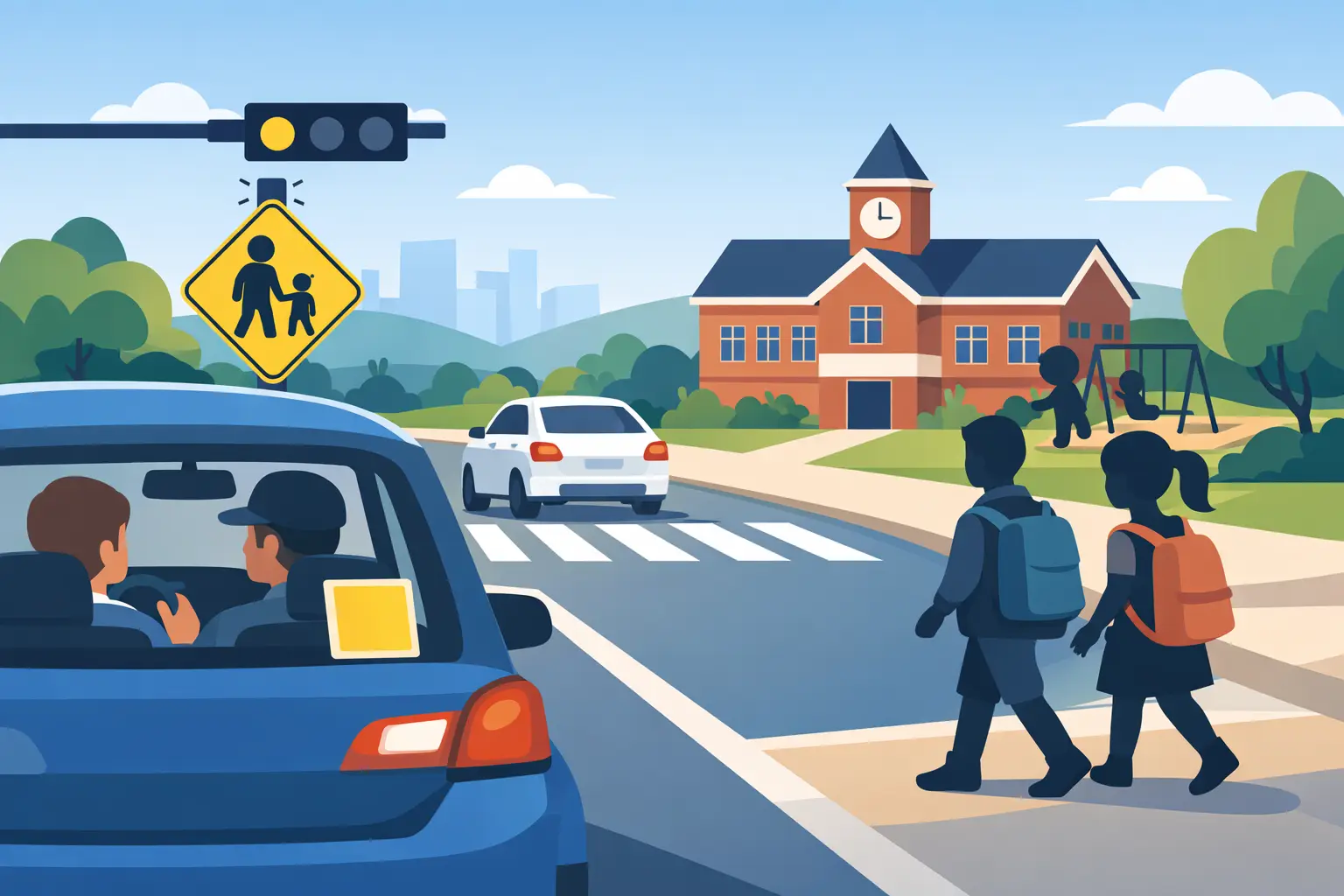
A school zone can change from an ordinary suburban street to a busy, unpredictable driving environment in seconds. This Victorian school zone driving guide helps learner drivers recognize the signs early, reduce speed smoothly, and make safe decisions when children, parents, buses, bicycles, and parked cars all compete for space.
For learners in Melbourne’s eastern suburbs, school-zone driving is also a practical VicRoads test skill. Examiners look for more than whether you can see a 40 km/h sign. They want to see calm observation, safe speed control, good gap judgment, and awareness of people who may step into the road without warning.
Victorian School Zone Driving Guide: Know When 40 km/h Applies
In Victoria, many school zones have a 40 km/h speed limit during the days and times shown on the signs. These times can vary, so do not rely on a school’s bell schedule, the traffic around you, or what you remember from another location. Read the time plates every time you enter the area.
Some locations use electronic school-zone signs, while others use fixed signs with displayed days and times. When the school-zone limit is operating, 40 km/h is the maximum speed, not a target you need to reach. If traffic conditions, wet roads, glare, or children near the curb make 40 km/h feel too fast, slow down further when it is safe to do so.
A common learner mistake is braking late after noticing the sign. Instead, scan well ahead. As soon as you see a school-zone sign, check your mirrors, ease off the accelerator, and brake progressively. In an automatic car, this gives you time to settle the vehicle at a safe speed without a sudden stop that may surprise the driver behind.
Keep following the lower limit until you pass the school-zone end sign or the time restriction no longer applies. Do not accelerate just because the school buildings are behind you. The limit is controlled by the signs, not by where you think the school property ends.
Slow Down Before the Risk Appears
Children do not always behave like predictable pedestrians. They may run after a friend, step out from between vehicles, ride quickly toward a crossing, or turn around while talking. Parents may be focused on loading bags and car seats. This is why safe school-zone driving is based on anticipation rather than quick reactions.
Look beyond the car directly in front of you. Scan the sidewalks, driveway exits, parked vehicles, crossings, and gaps between cars. If your view is blocked by a large SUV, bus, or delivery vehicle, reduce speed and be prepared to stop. Never assume the road is clear simply because you cannot see anyone.
Extra space matters. Leave a larger following gap than you might on an open road, especially in wet weather or when cars are stopping frequently. The vehicle ahead may brake suddenly for a child, a crossing supervisor, or a parent reversing out of a parking space. A calm gap gives you choices. Following too closely removes them.
You may also feel pressure from a driver behind you who wants to travel faster. Stay focused on the posted limit and the conditions ahead. Do not speed up to please another driver. Hold a steady, legal speed, avoid unnecessary braking, and let them make their own safe decision when an appropriate opportunity arises.
Crossings, School Buses, and Turning Traffic
School crossings need your full attention. Watch for crossing supervisors, children waiting at the curb, and people already on the road. Approach at a speed that allows you to stop smoothly. If a pedestrian is crossing, wait patiently and check both sides before moving off again. One child crossing does not mean another child is not about to follow.
When turning at an intersection near a school, slow down early and look carefully in the direction of your turn. In Victoria, drivers must give way to pedestrians crossing the road they are turning into. Check for pedestrians before beginning the turn, then continue watching through the turn. A quick glance is not enough when someone may be hidden by your windscreen pillar or another vehicle.
School buses create their own set of risks. Children can appear in front of or behind a stopped bus, often where your view is limited. Reduce speed, scan around the bus, and be ready for movement from either side of the road. Never overtake a vehicle simply because it is moving slowly near a school. First work out why it has slowed down.
Be especially careful around pickup and drop-off areas. Cars may pull away from the curb, reverse from driveways, open doors, or stop in places that make the road narrow. Keep a safe distance from parked cars and avoid weaving around them unless you have a clear view, enough room, and it is legal to proceed.
Parking Rules Protect Visibility
Poor parking can make a school zone far more dangerous. Stopping too close to a crossing, driveway, intersection, or bus stop can block sight lines for drivers and pedestrians. In Victoria, restrictions near children’s crossings and other marked areas are designed to keep people visible, so always read the signs and road markings before stopping.
For learner drivers, the safest approach is to plan ahead. If you are being picked up or dropped off near a school, choose a legal location away from the busiest crossing point and walk the remaining distance if needed. It may be less convenient, but it reduces pressure and gives you more room to pull in and out safely.
Avoid double parking. Even for a quick pickup, it can hide children from passing drivers, obstruct traffic, and create a stressful situation when you need to re-enter the lane. A legal parking space a little farther away is usually the safer choice.
Build a Simple School-Zone Routine
A reliable routine helps new drivers stay composed. Start by identifying the zone early: look for the school-zone signs, the time plates, flashing displays, crossing flags, and heavier pedestrian activity. Then check your mirrors, reduce speed gently, and keep your eyes moving between the road ahead, sidewalks, parked vehicles, and mirrors.
As you approach a crossing or congested pickup area, cover the brake if appropriate and ask yourself one practical question: if someone stepped out now, could I stop safely? If the answer is no, you need more space or less speed.
When moving off after stopping, check mirrors, look ahead, and complete the observation checks needed for your situation. For example, pulling out from the curb requires a careful mirror check and head check for bicycles, scooters, and vehicles approaching from behind. School areas often have young riders who may travel close to parked cars or change position unexpectedly.
This routine is useful in a driving test because it shows planned observation rather than last-second correction. It is also useful long after the test, when you are driving independently during busy morning or afternoon pickup times.
Common Mistakes Learners Can Avoid
The first mistake is treating 40 km/h as optional when no children are visible. The sign and its operating times control the limit. Children can be hidden, and school traffic can change quickly.
The second is focusing only on the speedometer. You should check your speed regularly, but your eyes must spend most of their time looking ahead and scanning for hazards. Brief speedometer checks, combined with a steady accelerator and early braking, are better than staring down at the dashboard.
The third is rushing through a gap between parked cars or around a bus. If you cannot see, you cannot confidently predict what may enter your path. Slow down and wait until you have a clear view.
The fourth is becoming flustered after another driver honks or follows closely. Safe driving is not about reacting emotionally to other road users. Keep your attention on the limit, your space, and the people most at risk around you.
Practice on the Roads You Will Actually Drive
School-zone confidence comes from guided practice, not from memorizing rules once. A patient instructor can help you practice smooth speed reduction, scanning around visual obstructions, safe turns near crossings, and calm decision-making in busy local conditions. This is particularly helpful for first-time learners and overseas license holders who are getting used to Victorian signs, kilometers per hour, and local road rules.
Green Signals Driving School can tailor lessons around the kinds of school-zone and suburban-road situations you are likely to meet in Ringwood, Blackburn, Nunawading, Vermont, Glen Waverley, Box Hill, Mitcham, and nearby areas. Practicing in a dual-control vehicle with an experienced instructor gives you time to build habits without feeling rushed.
The goal is not to fear every school zone. It is to approach each one with enough time, space, and attention to protect the people around you. That calm habit will make every drive safer, whether you are heading to a VicRoads test or simply driving home.