
How to Read Road Signs Before Your VicRoads Test
Uncategorized | 19 September, 2026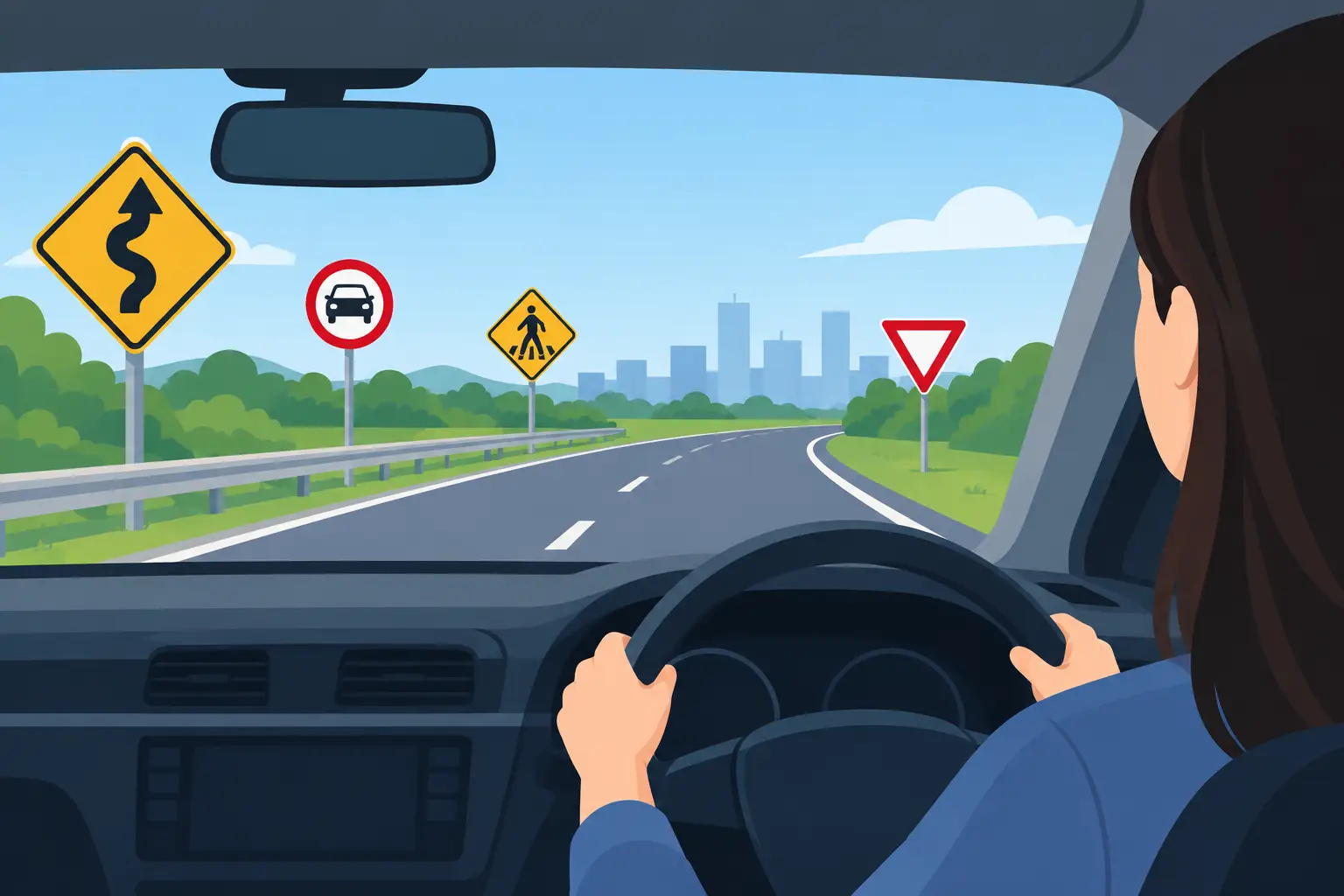
A road sign can change what you need to do in seconds. On a busy Melbourne street, you may be watching for pedestrians, checking mirrors, and planning your next turn when a sign tells you the speed limit has changed or that you cannot turn right. Learning how to read road signs is not about memorizing every sign in isolation. It is about spotting them early, understanding their message, and responding safely before you reach them.
For learner drivers and overseas license holders, signs are also a major part of safe driving assessments. Your driving examiner expects you to notice signs without being prompted and adjust your speed, position, and decisions accordingly.
Start With the Sign’s Shape and Color
Road signs are designed to give you clues before you can read every word or symbol. Their shape and color usually tell you what type of message is coming. This matters when you are approaching a sign at speed, in rain, or among heavy traffic.
Red, black, and white signs usually give a rule. They may tell you what you must not do, where you can park, or which direction traffic must travel. Yellow and black signs warn you about a hazard or changing road condition ahead. Green, blue, and white signs generally provide guidance, such as directions, lanes, services, or street information.
A red circle with a line through it means the pictured action is prohibited. For example, a right-turn arrow crossed by a red line means no right turn. A red octagon is always a stop sign. A red and white inverted triangle is a give way sign. These are signs you need to act on, not simply notice.
Regulatory signs: the rules you must follow
Regulatory signs tell drivers what is legally required, permitted, or prohibited. Speed limit signs are among the most important. Once you pass a new speed limit sign, you must be at or below that limit as soon as it is safe to do so. Do not wait until the next intersection or rely on the speed of the car in front.
Parking signs can be more challenging because several conditions may appear on one pole. Read them from top to bottom and check the arrows. The arrow shows the section of road covered by that instruction. A time limit, such as two-hour parking, may apply only on stated days and times. Outside those times, a different lower sign may control the space.
Other common regulatory signs include no entry, one way, keep left unless overtaking, no U-turn, no stopping, clearway, and pedestrian crossing rules. Treat these signs as instructions that shape your driving plan. If you see a no-right-turn sign, begin preparing early to continue straight or choose a legal alternative route.
Warning signs: slow down and look ahead
Warning signs are often yellow diamonds with a black symbol. They alert you to something that may require a lower speed, more space, or greater attention. Common examples include sharp curves, side roads, roundabouts, traffic lights ahead, pedestrian crossings, cyclists, merging traffic, and uneven surfaces.
A warning sign does not always mean you must stop. It means you should assess the risk and drive at a speed that gives you time to respond. A curve warning, for instance, is your cue to reduce speed before entering the bend, not while turning the steering wheel halfway through it.
Pay close attention to advisory speed signs beneath curve and ramp warnings. These yellow signs suggest a safe speed for the specific hazard in good conditions. If the road is wet, visibility is poor, or you are still building confidence, a slower speed may be appropriate.
How to Read Road Signs While You Drive
Knowing what a sign means is only half the skill. The other half is creating enough time to use that information. New drivers sometimes look directly in front of the car for too long. Instead, scan well ahead, then return your attention through mirrors, the road surface, and nearby traffic.
In suburban streets, make a habit of checking for signs after every turn. The speed limit may change when you enter a different road, school zone, shopping area, or built-up street. In Melbourne, do not assume the speed limit is the same just because the road looks similar to the one you left.
Use a simple sequence: see the sign, understand it, plan, then act. If you see a lane-use sign showing that your lane becomes left-turn only, check mirrors, indicate, and move lanes early if it is safe. Sudden decisions create risk and can lead to test errors. Missing a turn is usually safer than cutting across lanes or disobeying a sign.
Read signs in groups, not one at a time
At major intersections, signs often work together. You might see a speed limit sign, a lane-direction sign, traffic lights, a tram warning, and parking restrictions within a short distance. Rather than becoming overwhelmed, identify the signs that affect your immediate path first.
Ask yourself: What does this sign require me to do now? What could affect me next? A lane arrow may determine where you need to position the car. A pedestrian crossing sign may mean you need to check both sides of the road. A school zone sign may require you to slow down during the listed times.
This is especially useful near VicRoads test areas, where instructors may guide you through busy intersections, roundabouts, shopping strips, and residential streets. Your examiner is looking for safe observation and independent decision-making, not perfect recall under pressure.
Signs That Commonly Catch Learner Drivers Out
Some signs are easy to recognize but easy to apply incorrectly. School zone signs are a common example. The lower speed limit applies only during the days and times shown on the sign, so read the entire display. Still, children may be present at any time, and you should remain alert around schools.
Give way signs also need more than a quick glance. A give way sign means you must give way to vehicles, cyclists, and pedestrians that have priority. At a roundabout, slow down, look to your right for approaching traffic, and give way when required. Do not enter simply because the vehicle behind you seems impatient.
Keep clear markings and signs are another frequent source of mistakes. You must not stop in a keep clear area, even if traffic ahead is backed up. Wait before the markings until you can clear the space completely.
Temporary roadwork signs deserve the same attention as permanent signs. Orange or yellow signs, cones, changed lane markings, reduced speeds, and workers near traffic all require you to slow down and follow the temporary direction. Conditions can change quickly, particularly around construction sites and lane closures.
Build Sign Awareness Before Your Test
The best way to become confident is to practice reading signs on real roads, not only from a handbook. During each drive, choose one focus. On one lesson, pay close attention to speed signs and where limits change. On another, practice reading lane arrows and planning ahead at intersections. Repetition turns sign reading into a calm habit.
You can also talk through what you see while practicing with a qualified supervising driver. Say, “Speed limit is 40,” “left lane turns left,” or “pedestrian crossing ahead.” Speaking the information helps connect recognition with action. As your confidence grows, you will process signs without needing to say every message aloud.
For overseas license holders, allow time to learn local wording, symbols, parking rules, tram-related signs, and give way expectations. Familiar driving experience is valuable, but rules are not identical in every country. A few focused lessons can help replace uncertainty with clear, safe routines.
At Green Signals Driving School, instructors can build road-sign practice into your individual lessons, using local roads and test-style situations to help you make decisions independently. The goal is not to rush through signs or memorize routes. It is to develop the observation skills that keep you safe wherever you drive.
On your next drive, choose a simple challenge: notice every sign that affects your next 10 seconds of driving, then respond smoothly and early. That small habit can make busy roads feel far more manageable.