

Dual Control Versus Standard Cars for Learners
Uncategorized | 23 September, 2026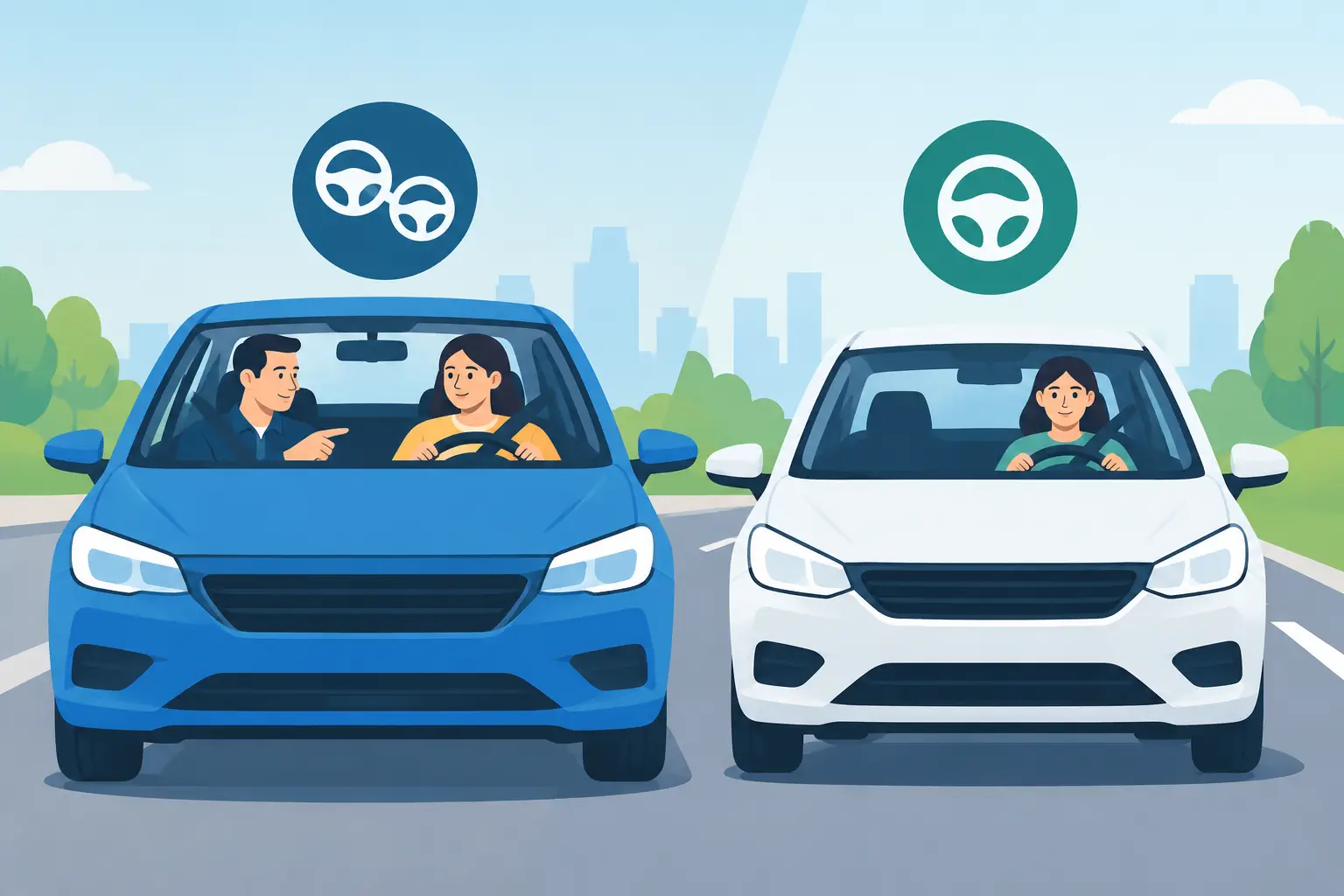
A learner approaches a busy Ringwood intersection, hesitates as the light changes, and presses the brake a little too late. In the dual control versus standard cars decision, that small moment explains the real difference. A dual-control training car gives the instructor a second set of pedals, allowing them to help protect the learner, other road users, and the lesson itself when needed.
For most first-time learners and drivers converting an overseas license in Melbourne, a dual-control car provides a calmer place to build skills. It does not mean the instructor drives the car for you. You remain in the driver’s seat, make decisions, and develop the habits needed for independent driving. The extra controls are there as a safety backup while you learn how Victorian roads, traffic conditions, and test expectations work.
Dual Control Versus Standard Cars: The Key Difference
A standard car has pedals only on the driver’s side. If you are practicing with a parent, friend, or supervising driver, they can offer guidance but cannot physically brake or control acceleration. That arrangement can work well once you are comfortable with the basics and are practicing familiar roads at a suitable level.
A dual-control car has an additional brake pedal and usually an accelerator pedal for the qualified instructor. The learner still controls the steering wheel, indicators, mirrors, and primary pedals. However, if a hazard develops, the instructor can brake or limit acceleration quickly. This is particularly valuable in early lessons, on unfamiliar roads, and during more complex traffic situations.
The purpose is not to remove responsibility from the student. Good instruction gradually reduces the need for intervention. As your observation, speed control, positioning, and decision-making improve, you should be driving with increasing independence. The dual controls simply provide a safer margin while those skills are still developing.
Why Dual Controls Help Learners Build Confidence
Confidence is not about feeling fearless behind the wheel. It comes from repeating the right actions until they become familiar: checking mirrors before changing direction, choosing a safe gap, maintaining a suitable speed, and responding early to developing hazards. Learners make mistakes while building these habits. A dual-control vehicle gives room for mistakes to become teaching moments rather than frightening incidents.
This can make a meaningful difference for nervous learners. Some students are worried about stalling traffic, misjudging braking distance, or entering roundabouts. Others may have had a difficult first lesson with a relative and now feel tense before every drive. Knowing that a patient instructor can assist with the pedals can lower that pressure enough for the learner to focus on the road ahead.
Dual controls can also support clearer coaching. An instructor can talk you through an approach to a pedestrian crossing or a right turn at an intersection while remaining ready to intervene if necessary. When the immediate risk is managed, feedback can be specific and calm: look further ahead, begin braking earlier, or wait for a safer gap. That is far more useful than vague advice to be careful.
Safety matters most in changing conditions
Melbourne driving lessons can include tram routes, busy shopping strips, school zones, multilane roads, wet-weather braking, and residential streets with limited visibility. Eastern suburbs routes around Box Hill, Glen Waverley, Blackburn, Nunawading, Mitcham, and Ringwood can change quickly from quiet streets to complex intersections.
A learner may understand a rule when parked at the curb, yet need time to apply it with traffic moving around them. Dual pedals add protection during that transition. They are especially useful when a learner is still learning to judge speed, follow a safe distance, or react to unexpected hazards such as a car reversing from a driveway.
A well-equipped training vehicle adds further reassurance. Features such as electronic stability control, anti-lock brakes, traction control, emergency brake assist, lane support, and multiple airbags are designed to improve safety. These systems do not replace attentive driving, but they complement skilled instruction and a well-maintained car.
When a Standard Car Can Be the Right Choice
Standard cars still have a valuable place in learning. Practicing in the car you expect to drive after receiving your license helps you become familiar with its mirrors, controls, visibility, braking feel, and parking reference points. It is also where supervised practice between professional lessons often happens.
For a more experienced learner, standard-car practice is useful for building consistency. After you have learned a maneuver with an instructor, repeating it in a family vehicle can help it feel natural. You might practice smooth stops, scanning at intersections, three-point turns, parking, or following the same local route at different times of day.
The trade-off is that the supervising driver needs to choose practice conditions carefully. A quiet route and low traffic volume may be appropriate at first. A crowded road, unfamiliar test area, or difficult weather condition may not be the best place to attempt a new skill without an instructor who has dual pedals.
For international drivers, the issue is often less about operating the car and more about local habits. You may already have years of driving experience, but Victorian road rules, hook turns, tram stops, give-way expectations, speed zones, and VicRoads test standards can feel different. A dual-control lesson gives you a safe opportunity to adjust those habits before practicing more independently.
Does a Dual-Control Car Make Passing Easier?
A dual-control car does not guarantee a first-attempt pass. The VicRoads license test assesses whether you can drive safely and independently, so you must demonstrate sound observation, control, road positioning, and judgment without the instructor assisting you.
What a dual-control lesson can do is help you prepare more effectively. You can practice test-relevant skills in a structured environment, receive immediate feedback, and experience common local road situations with a qualified instructor beside you. That may prevent a small pattern, such as late mirror checks or rolling stops, from becoming a habit.
The right number of lessons depends on your current skill level. A novice driver may benefit from five to ten lessons alongside regular supervised practice. A learner who already drives confidently but needs refinement before a test may need three to five focused lessons. Drivers converting an overseas license often benefit from three to five lessons centered on Victorian rules, test routes, and local decision-making.
The goal is readiness, not simply completing a set number of sessions. A good instructor will identify what you do well, explain what needs attention, and organize lessons around practical next steps.
Choosing the Right Learning Setup
Think about where you are starting. If you have never driven, feel anxious, or need support with traffic awareness, beginning in a dual-control automatic car is usually the sensible option. You can learn the fundamentals without adding the concern that a supervisor has no physical way to help if something goes wrong.
If you already have a solid foundation, combine professional dual-control lessons with supervised practice in a standard vehicle. Use the lesson to learn and correct technique, then use your own practice time to reinforce it. This balance can be both practical and cost-effective.
It also helps to choose an instructor you can communicate with comfortably. Clear, patient instruction matters, particularly when you are learning unfamiliar road rules or rebuilding confidence after a break. Learners who prefer support in English, Hindi, or Gujarati may find that easier communication helps them understand feedback and make faster progress.
At Green Signals Driving School, lessons are delivered in modern automatic dual-control vehicles so students can focus on safe driving habits with qualified support beside them. Male and female instructor availability gives learners more choice in finding an environment where they feel comfortable and ready to learn.
Your first few drives do not need to feel perfect. They need to feel safe, purposeful, and a little more manageable each time. Start where your confidence is now, practice consistently, and let each well-handled decision move you closer to driving independently.