
How to Pass Cyclists Safely on Melbourne Roads
Uncategorized | 13 September, 2026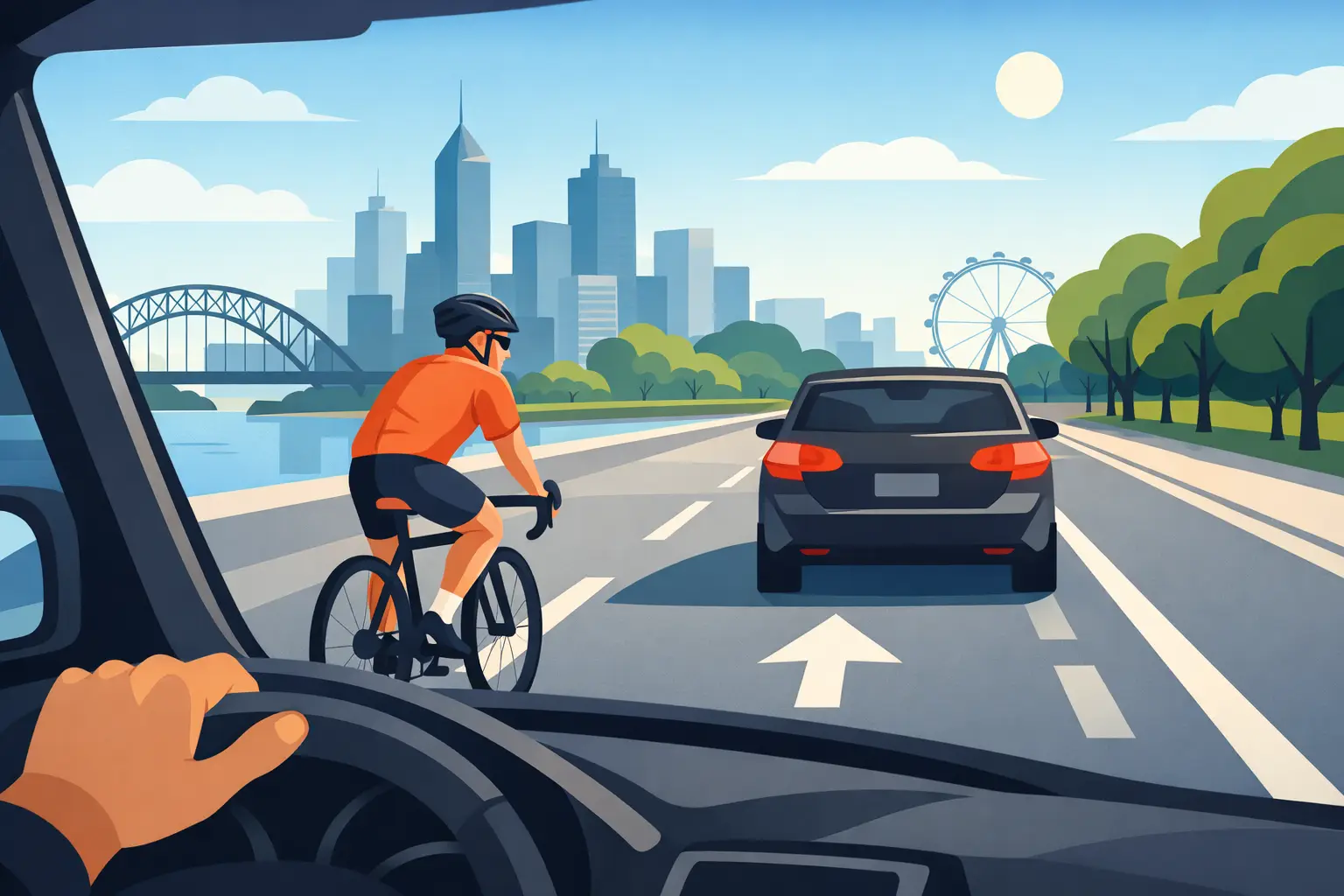
A cyclist may be traveling far more slowly than your car, but that does not make passing a simple maneuver. Knowing how to pass cyclists safely means reading the road ahead, leaving real space, and being prepared to wait when the conditions are not right. For learner drivers in Melbourne, this is a skill that builds both safer habits and calmer decision-making for the VicRoads drive test.
How to Pass Cyclists Safely: Start With Space
In Victoria, drivers must leave a minimum passing distance when overtaking a cyclist: at least 1 meter when traveling at 60 km/h or below, and at least 1.5 meters when traveling above 60 km/h. Treat this as the minimum, not a target. If the road is wet, the cyclist is moving around potholes, or there are parked cars nearby, giving more room is the safer choice.
A bicycle is not confined to the gutter. Cyclists may need to ride farther from the curb to avoid drain covers, broken pavement, opening car doors, or debris. They may also position themselves in the lane before a roundabout, intersection, or narrow section of road. Do not pressure them by driving close behind or trying to squeeze through with insufficient room.
The safest pass should feel unremarkable to the cyclist. Your car moves out with plenty of clearance, passes steadily without sudden acceleration, and returns to the lane only after there is enough room.
Read the Road Before You Move
A safe overtake starts well before you steer around the cyclist. Ease off the accelerator early and create a following gap. This gives you time to assess oncoming traffic, road markings, intersections, parked vehicles, and the cyclist’s position.
Use your mirrors, then check your blind spot before changing position. Signal clearly when it will help other road users understand what you are doing. If you need to cross into another lane to give the required space, make sure that lane is clear and that the maneuver is legal and safe.
Do not pass simply because the cyclist is moving slowly. Wait if your view ahead is blocked, if an oncoming vehicle would force you back too soon, or if the road narrows. A few extra seconds behind a bicycle is always better than creating a close pass.
Watch for places where cyclists may change position
Cyclists are especially likely to move within their lane when approaching intersections, roundabouts, traffic islands, parked cars, and turning lanes. A rider may look over their shoulder and move out to prepare for a right turn. They may also avoid the “door zone” beside parked cars, where a car door can open unexpectedly.
If you see a cyclist glance back, signal, or begin moving toward the center of the lane, do not attempt to overtake. Let them complete their movement first. Patience here prevents one of the most common and dangerous conflicts on suburban roads.
When You Should Wait Instead of Passing
Being a confident driver does not mean passing at every opportunity. It means recognizing when the road does not offer a safe option.
Wait behind the cyclist when approaching a pedestrian crossing, railway crossing, crest of a hill, blind curve, roundabout, or intersection. These locations reduce your view, increase the chance of another road user entering your path, or give the cyclist a valid reason to take more of the lane.
You should also wait when there is oncoming traffic, when the lane is too narrow to leave the required distance, or when a parked vehicle makes the cyclist’s route unpredictable. On busy roads in Ringwood, Box Hill, Glen Waverley, and other eastern suburbs, traffic can change quickly near shopping areas, schools, and bus stops. Holding back calmly is often the best decision.
Avoid passing only to stop immediately afterward. If a red light, queue of traffic, or turning point is just ahead, passing can place the cyclist beside or in front of your car again within seconds. Stay behind them until traffic begins moving and there is enough clear road to complete the maneuver safely.
Pass Smoothly and Return With Care
Once you have checked that it is safe to overtake, move out gradually. Keep your steering smooth and leave the required gap for the full length of the pass. Do not accelerate aggressively. Sudden noise and speed close to a cyclist can be intimidating, even when there appears to be enough room.
Keep looking ahead as you pass. A cyclist may need to avoid a hazard, and another vehicle may be entering from a side street or driveway. If the cyclist is riding with children, in a group, or carrying cargo, allow extra time and space. Their speed and line may be less predictable than a solo rider on a clear road.
Before returning to your lane, check your interior mirror and make sure you can see the cyclist with a safe buffer behind your vehicle. Cutting back in too early can force a cyclist to brake or move toward the curb. This is particularly risky near parked cars, where there may be nowhere safe for them to go.
Intersections Need Extra Attention
Many cyclist crashes happen at intersections rather than during a straightforward pass. A driver overtakes a cyclist, then turns left across their path. The driver may have seen the cyclist moments earlier but fails to check again before turning.
If you are turning left, look for cyclists before you begin slowing down, check mirrors, signal early, and check again before turning. Do not move into a cyclist’s path or assume they will stop for your turn. A cyclist traveling straight ahead may be harder to notice because of their smaller size, especially in traffic.
At a roundabout, give cyclists enough space to take the lane when needed. Do not try to overtake them on the approach if doing so would place your vehicle beside them as you enter or exit. Let them establish their position, then proceed when it is safe.
Do not forget the door check
Passing safely also matters after you park. Before opening your door, check mirrors and look over your shoulder for cyclists approaching from behind. This is often called a door check, and it helps prevent a cyclist from riding into an unexpectedly opened door.
Make it a routine every time you park on a street. The same awareness that helps you pass a cyclist safely should continue until you have fully left the traffic environment.
Common Mistakes Learner Drivers Can Avoid
New drivers sometimes focus so closely on the cyclist that they forget to scan the wider road. Others become nervous and drive too slowly beside the cyclist, extending the time their car is close to them. The better approach is to assess early, wait if needed, then complete a legal pass smoothly and decisively.
Another mistake is relying only on mirrors. Mirrors help, but they do not replace a shoulder check before moving sideways. Cyclists can be difficult to see in blind spots, particularly when you are changing lanes or pulling away from the curb.
Finally, never use the horn to make a cyclist move aside unless there is an immediate danger. A horn can startle a rider and cause them to wobble or brake suddenly. Give them time, give them space, and let the road situation guide your decision.
Practice the Skill Before Test Day
Passing cyclists is a practical skill, not something to memorize from a rule book. During lessons, practice recognizing early warning signs: narrow lanes, parked cars, approaching intersections, and limited visibility. Ask your instructor to talk through the mirror checks, road positioning, and decisions that make each pass safe.
At Green Signals Driving School, learners can build this awareness in a calm, dual-control training vehicle while practicing on the local roads they are likely to use every day. This can be particularly helpful for overseas license holders adjusting to Victorian road rules and for learners preparing for their VicRoads test.
Every safe pass begins with the same simple choice: do not rush. Leave room, look twice, and wait when the road does not give you a safe path around.